This guide covers everything to sort before a Palau liveaboard: your level, flights, entry rules, kit, money and life on board. Four things matter most. You need Advanced Open Water and a minimum number of logged dives. Reef hooks and SMBs cannot be rented, so bring your own or buy them on board. State permits and taxes are paid on board. And every visitor signs the Palau Pledge on arrival.

At a glance
| Boat | Palau Siren, 40 m, up to 16 guests in 8 cabins |
|---|---|
| Routes | Palau Islands; Full Moon Spawning; New Moon Spawning |
| Nights | Palau Islands 10 nights; spawning trips 7 or 10 nights |
| Embark and disembark | Sam’s Tours, Koror: boarding 17:30, leaving 10:00 |
| Level required | Advanced Open Water or equivalent; 30 logged dives (Palau Islands) or 50 logged dives (spawning trips) |
| Water temperature | 28-30°C all year (operator data) |
| Currency | US dollar |
| Time zone | UTC+9 |
| Plugs | Type A and B, 120 V, 60 Hz |
| Best months | October to June (dry season, per the operator); diving runs all year |
Certification, logged dives and documents to bring
Palau is current diving, and the operator sets clear minimums for every route.
What the operator requires
- Palau Islands (10 nights): “PADI Advanced Open Water or equivalent, minimum 30 logged dives (mandatory), experience and comfortable in strong currents. Nitrox is strongly recommended.”
- Full Moon and New Moon Spawning (7 or 10 nights): “PADI Advanced Open Water or equivalent, minimum 50 logged dives (mandatory), experience and comfortable in strong currents. Nitrox is strongly recommended.”
The operator says the spawning dives are only for experienced divers, because currents are often very strong where the action happens.
Bring proof
- Your certification card (physical or digital).
- Your logbook, paper or app, showing your dive count.
- Your nitrox card, if you plan to dive nitrox.
If you are below the minimum
You cannot complete Advanced Open Water on board Palau Siren. Get it done at home before you travel. You can register for PADI Advanced Open Water and Enriched Air Nitrox online learning through the operator. On board, the operator lists PADI Enriched Air Nitrox, PADI Refresher (Scuba Review) and PADI Deep Diver Speciality. Courses are subject to availability and must be pre-booked so an instructor is free. If you are unsure whether you meet the minimum, talk to us before you book.
Getting there from the UK
Palau’s international airport is Roman Tmetuchl International (ROR), on Babeldaob island, near Koror. There are no direct flights from the UK. You connect through a hub in Asia or the Pacific. Scheduled services have recently included Manila, Taipei, Guam and Tokyo Narita. Schedules change often, so check current routes before you book flights.
Transfers and boarding
Transfers between Koror Airport or your hotel and the boat are included on embarkation and disembarkation days, depending on your flight times. Boarding is at Sam’s Tours in Koror at 17:30. The first evening is introductions, boat and safety briefings, and dinner. There is no diving on embarkation day. On the last morning you leave the boat at Sam’s Tours at 10:00.
Should you arrive early?
With long connections and a 17:30 boarding time, it makes sense to fly in a day or more early so a delayed flight does not cost you the start. Hotels and extra transfers are not included, so we can help you plan them. One point to watch: the operator says guests doing activities in Palau before or after the trip may need extra permits if their total time in Palau goes over 10 days.
Entry, visas and travel advice
This is a summary of the UK government’s travel advice for Palau, checked on 3 November 2026 (page last updated 10 December 2025). Rules can change, so check the latest FCDO advice for Palau before you travel.
- UK passport holders do not need a visa for stays of up to 30 days. A 30-day tourist visa is issued on arrival.
- You may need to show proof of onward or return travel.
- Your passport must be valid for at least 6 months after your arrival date and have at least 2 blank pages.
- You must complete the Palau entry form within 72 hours of arrival.
- You must sign the Palau Pledge, which is stamped in your passport on arrival.
- At customs, declare personal items worth more than US$400 and cash of US$10,000 or more.
- It is illegal to bring reef-toxic sunscreen into Palau.
The FCDO also notes heavy penalties for drug offences, a legal drinking age of 21, and that drinking alcohol in public is illegal outside licensed premises. Unexploded Second World War ordnance remains, especially on Peleliu and Angaur. Do not touch anything metal you find; photograph it and report it.
Health and insurance
We cannot give medical advice. Here is what to check and who to ask.
Health
- The FCDO advises checking vaccine recommendations at least 8 weeks before your trip. Talk to your GP or a travel clinic, and see NHS Fit for Travel for Palau.
- The FCDO lists dengue and Zika as health risks in Palau.
- Ask a doctor, ideally one with diving medicine experience, whether you are fit to dive.
- Some UK medicines have a different legal status in Palau. Check before you pack them.
The FCDO says Belau National Hospital in Koror is the only national hospital and has a hyperbaric chamber for diving accidents. Serious cases may need evacuation, and doctors often expect immediate cash payment. The emergency number is 911.
Insurance
Divers Alert Network says very few travel policies cover diving incidents, that most of those exclude dives deeper than 30 m, and that chamber treatment is not typically covered by medical or travel insurance. Read your policy wording and check:
- The maximum depth covered, and whether nitrox is covered.
- Hyperbaric (recompression) treatment and its limit.
- Medical evacuation and repatriation, as the FCDO advises.
- Any rule that you dive with a guide or hold a set certification.
- Cover for your planned activities, including any land tours.
Money on board
Palau uses the US dollar. The Palau visitor authority advises carrying some cash, and the FCDO says doctors and medical centres often expect immediate cash payment.
Included in your trip
- Full board: breakfast, lunch, dinner and snacks.
- Unlimited drinking water, tea, coffee, fruit juice and soft drinks.
- Up to 4 dives a day with an 11 litre (AL80) cylinder and air fills.
- Weights and weight belt.
- Airport or hotel transfers on embarkation and disembarkation days.
- On spawning trips, the spawning itinerary fee is included in the cruise price.
Paid on board
Palau Islands State Permits and Taxes are added to your on-board bill and paid before you leave the boat. The operator currently charges US$300 per person on 10-night trips and US$230 per person on 7-night trips (checked 3 November 2026; confirm before travel). Rock Islands permits last a maximum of 5 days, so each trip needs 2 permits. Surcharges, permits and taxes can change without notice.
A 10% Palau Goods and Services Tax applies to payments made on board for equipment rental, nitrox, courses, alcohol, laundry and merchandise. Also paid on board: beer, cocktails, wine and spirits, Wi-Fi, and any rental or nitrox you did not prepay. Rental, nitrox, courses and permits can also be pre-booked and prepaid when you book.
Fuel surcharge: the operator’s information is not consistent, so we confirm whether one applies to your departure before you travel.
Tips
Crew and dive guide gratuities are not included. The operator does not publish a set amount, so tip what feels right.
What to pack
Dive kit
- Reef hook. The operator calls it an essential piece of diving equipment in Palau’s channels. It cannot be rented.
- SMB. Also not available to rent. Bring your own or buy one on board.
- Dive computer. Not part of the rental set, so bring yours.
- Torch. Not in the rental set, and needed in the darker chambers of Chandelier Cave and for night dives.
- Wetsuit. The operator says 28-30°C water means a 3 mm suit is usually enough.
- Mask, fins, regulator and BCD, unless you are renting.

Rental and nitrox
Palau Siren has equipment rental and a nitrox compressor. All rental must be pre-booked so the right sizes are on board. Nitrox is strongly recommended on every route. Rebreather diving is generally only possible on dedicated technical or wreck itineraries. If you need oxygen or Sofnolime, ask when you confirm your trip, because shipping times are long.
Clothes and personal items
- Light, casual clothes; it is warm all year.
- A light rain jacket. The FCDO says rainfall is higher from April to November, peaking in July and August.
- Mineral sunscreen with zinc oxide or titanium dioxide only. Reef-toxic sunscreen is banned.
- Hat, sunglasses and a rash vest.
- Any personal medicines, in original packaging.
- Towels and bathrobes are provided in the cabins.
Camera kit and charging
The saloon has designated areas for charging and preparing camera and video kit. The dive deck has a separate rinse tank for cameras. Palau uses type A and B plugs at 120 V, so bring an adapter and check your chargers handle 120 V. We have not confirmed the socket types on board, so pack a multi-adapter to be safe.
Documents
- Passport valid 6 months beyond arrival, with 2 blank pages.
- Proof of onward or return travel.
- Palau entry form confirmation.
- Certification card, nitrox card and logbook.
- Insurance policy details and emergency numbers.
- Your booking confirmation.
A day on board Palau Siren
Palau Siren is a 40 m boat built in Sulawesi, Indonesia, from ironwood and teak. She takes a maximum of 16 guests.
A typical diving day
The operator offers up to 4 dives a day: 3 day dives and a sunset or night dive where possible. On spawning trips the fourth dive may be at sunrise, sunset or night, depending on spawning times. A typical day runs like this:
- Light breakfast, briefing and dive 1.
- Full breakfast, rest, briefing and dive 2.
- Lunch, rest, briefing and dive 3.
- Snack, rest, briefing and dive 4, where possible.
On days with a land tour (non-diving), only 3 dives are possible. Day 2 starts with a check dive. The 10-night Palau Islands trip offers up to 32 dives.
Skiffs and moorings
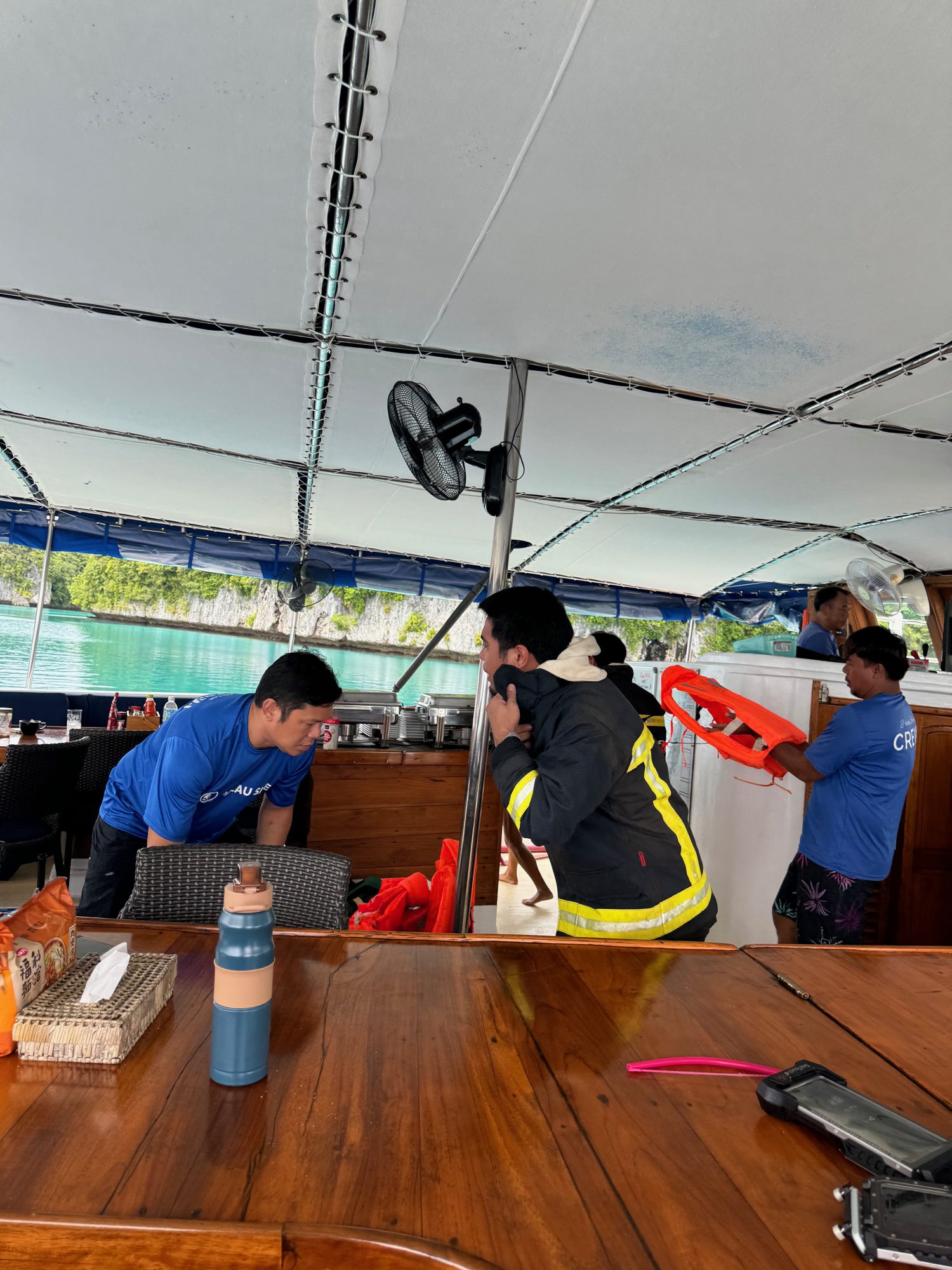
All liveaboards in Palau must use set mooring areas around the Rock Islands, so the big boat moves little. You dive from 2 shaded fibreglass skiffs. The ride from the boat to most sites usually takes 5-15 minutes.
Cabins
There are 8 cabins: 2 fixed double cabins at the bow, 4 fixed twins and 2 flexible twins that convert to doubles. Every cabin has its own air conditioning control and an en-suite bathroom with hot water.
Food and spaces
Meals are served in a covered outdoor dining area. The air-conditioned saloon has a bar, seating and a large TV. The dive deck has personal storage for each diver and fresh water showers.

Wi-Fi and extras
Wi-Fi is paid for on board and depends on service availability, so expect to be offline at times. Kayaks, laundry and massage are also available.
Diving conditions to prepare for
For an overview of every route, see our Palau liveaboards page. Most diving is in the Rock Islands Southern Lagoon, with a day at Peleliu. Narrow channels and tidal currents shape every dive. The operator puts average visibility at around 30 m.
Seasons
| Months | Water | What to expect (operator data) |
|---|---|---|
| October to June | 28-30°C | Dry season, best visibility and conditions |
| July to September | 28-30°C | Wet season, still diveable |
For more on timing, see our compare dive destinations month by month.
Palau Islands (10 nights)
The trip usually starts with wrecks around Malakal Harbour, then heads into the Rock Islands. It runs south via Ulong Channel, German Channel and Ngemelis Island to Peleliu. Expect drift dives, Second World War wrecks, caverns and night dives. Sites often include:
- Blue Corner: strong currents and reef hooks needed; sharks, snapper, barracuda and jacks are often seen.
- German Channel: best known for manta rays visiting cleaning stations.
- Blue Holes: a cavern lit by four openings above.
- Chandelier Cave: four chambers with stalactites; bring a torch.
- Wrecks: Iro Maru lies upright in 20 m; Teshio Maru rests on her side in 24 m; Chuyo Maru sits at 40 m with her deck at 30 m.
- Peleliu Cut: some of the strongest currents of the trip.
Palau’s waters are a designated shark sanctuary, and reef sharks and manta rays are often seen. Sightings are never guaranteed. Note that the Chuyo Maru’s depth is beyond the 30 m limit of many insurance policies.
Full Moon and New Moon Spawning trips
These are special departures timed to the moon. On Full Moon Spawning trips, the operator says red snapper (also called twin-spot snapper) gather in large numbers to spawn around the full moon, which draws predators. On New Moon Spawning trips, the operator says thousands of bumphead parrotfish gather in one area of Palau around the new moon each month to spawn. The Cruise Director gives talks on the ecology of these events and how to photograph them. Spawning behaviour depends on nature, so it is never guaranteed. The operator says blackwater diving may also be possible on most Palau Siren trips.

Responsible diving
- Sign and keep the Palau Pledge. It is a promise, stamped in your passport, to protect Palau’s environment while you are there.
- Use mineral sunscreen only. It is illegal to bring reef-toxic sunscreen into Palau or to use it there.
- Use your reef hook as briefed. Your guide explains where and how to hook in before each current dive.
- Respect the World Heritage site. The Rock Islands Southern Lagoon was inscribed by UNESCO in 2012.
- Leave wrecks and war relics alone. Look, photograph, and take nothing.
Your pre-trip checklist
4 weeks or more before
- Check your passport is valid 6 months beyond arrival, with 2 blank pages.
- Confirm your certification and dive count meet the minimum.
- See your GP or travel clinic about vaccinations and fitness to dive.
- Check your insurance covers diving depth, hyperbaric treatment and evacuation.
- Pre-book rental, nitrox, courses, oxygen or Sofnolime.
- Buy a reef hook and SMB if you do not own them.
- Book flights and any hotel nights.
1 week before
- Check the latest FCDO advice.
- Service and test your kit, computer and torch.
- Buy mineral sunscreen.
- Pack adapters for type A and B sockets.
Day before
- Complete the Palau entry form (within 72 hours of arrival).
- Pack cards, logbook and documents in your hand luggage.
- Carry some US dollars.
On board
- Join the boat and safety briefings on the first evening.
- Practise with your reef hook on the check dive.
- Settle your on-board bill, including permits and taxes, before you leave the boat.

Palau liveaboard pre-trip questions
What is a reef hook and do I need one?
A reef hook is a metal hook on a short line. You clip it to rock so you can hold your place in the current. The operator says it is essential in Palau's channels. Reef hooks and SMBs cannot be rented, so bring your own or buy one on board.
Do I need Advanced Open Water for Palau?
Yes. The operator asks for PADI Advanced Open Water or equivalent, with at least 30 logged dives on Palau Islands trips and 50 on spawning trips. You cannot complete Advanced Open Water on board, so do it before you travel.
Can I visit Jellyfish Lake?
Jellyfish Lake is snorkelling only (non-diving); scuba is not allowed there. The operator says the jellyfish populations have become seriously depleted, so it does not organise visits while that remains the case.
What are the Palau permits and taxes?
Palau Islands State Permits and Taxes are paid on board before you leave. The operator currently charges US$300 per person on 10-night trips and US$230 on 7-night trips (checked 3 November 2026; confirm before travel). A 10% GST applies to on-board purchases.
Do UK citizens need a visa for Palau?
No visa is needed for stays of up to 30 days; a tourist visa is issued on arrival. You must sign the Palau Pledge and complete the entry form within 72 hours of arrival. Check the latest FCDO advice before you travel.
How warm is the water and what wetsuit should I bring?
The operator gives 28-30°C all year and says a 3 mm wetsuit is usually enough.
What is the best time to dive Palau?
The operator describes October to June as the dry season, with the best visibility and conditions. July to September is the wet season but still diveable.
Is nitrox available?
Yes. Palau Siren has a nitrox compressor and the operator strongly recommends nitrox. Pre-book it, and bring your nitrox card.
Book your Palau liveaboard
Palau rewards divers who arrive prepared: a reef hook, the right card, and some dollars for the permits. If anything here is unclear, ask us. We have checked this guide against the operator’s information and official sources, and we confirm fees before you travel. See live Palau dates or read more about our Palau liveaboards.
Planning more than one trip? Read the Truk Lagoon pre-trip guide.
Leave a Reply